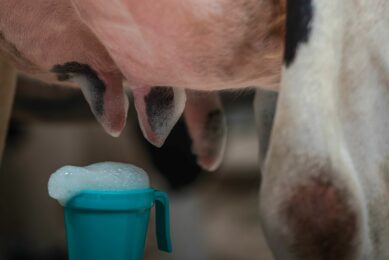
Milking time matters more than we think


There’s something almost meditative about walking into the milking parlour at dawn. The soft hum of the equipment warming up, the steam rising from freshly cleaned floors, the quiet anticipation in the eyes of the cows lining up one by one, ready for a ritual that’s repeated, without fail, usually twice a day. It’s a routine as old as dairy farming itself. But within this well-rehearsed dance between animal and human, between biology and machine, hides one of the most misunderstood – and underestimated – drivers of herd health and dairy performance: time.
Not time in the grand sense of seasons or lactations. No, we’re talking about minutes. Seconds, even. The kind of time you could almost overlook if you weren’t paying attention. But here’s the quiet truth we must start saying out loud: milking time matters more than we think. And shaving off even a few unnecessary seconds can change everything, from the comfort of a cow to the lifespan of a herd.
It sounds like a bold claim. Maybe even dramatic. But let me take you on a journey to show you why it’s not just accurate – it’s urgent.
The parlour as a pulse point
Every farm has a rhythm, and its milking parlour is the beating heart. It’s where everything converges: the performance of the equipment, the skill of the team, the mood of the herd, the health of the udders. It’s here that we see the true state of the operation – not in spreadsheets or reports, but in how the cows behave as they enter, how long they wait, how calmly they stand, and how quickly and completely their milk is let down.
Time, in this context, is not just a unit of measurement – it’s a mirror. If milking takes too long, it reflects inefficiencies in routine, discomfort in the cow, or imbalances in the system. If it’s too short, we may be rushing at the expense of completeness or care. But when milking time is optimised – not too rushed, not unnecessarily prolonged – something beautiful happens. Milk flows freely. The cow stands quietly. The equipment performs effortlessly. And the entire process feels… right.
Yet on many farms, we still treat time as either a secondary metric or an afterthought. We focus on yield, on somatic cell counts, on infection rates – and rightfully so. However, if we dig a bit deeper, we discover that many of those downstream problems share a common upstream cause: poor milking time management.
When seconds turn into symptoms
Consider this: a cow is a finely tuned biological system. Her milk ejection is a neuroendocrine reflex triggered by oxytocin, inhibited by stress, and shaped by experience. When milking is smooth, gentle, and timely, oxytocin flows, milk lets down fully, and her udder is emptied efficiently. But if she’s left too long under vacuum after her milk flow has ceased – what we call overmilking – her teats begin to swell. The tissue becomes engorged with blood and lymph. The sphincter at the end of her teat, which acts as her first line of defense against pathogens, can be damaged. It doesn’t always bleed or bruise, but it does suffer.
These aren’t just invisible injuries. They’re the seeds of mastitis, hyperkeratosis, and long-term udder degradation. The cow doesn’t cry out. She doesn’t complain. But over time, her behaviour shifts – she hesitates to enter the parlour, becomes restless during milking, or drops in production. And when we don’t respond to these subtle cues, we lose more than milk. We lose trust, longevity – we lose her.
Now multiply that by 100, 300, 1,000 cows – twice a day, 365 days a year – and you begin to see the scale of the problem. Every second of unnecessary milking time becomes a compounding factor. Every minute wasted becomes a risk magnified.
The high cost of low awareness
I once walked onto a farm where milking had quietly stretched to over eight minutes per cow. No one had noticed. The system hadn’t changed, the cows hadn’t revolted, and the milk still flowed. But the team had become desensitised to the gradual creep of time. They were operating on muscle memory, not awareness. As we began to measure and analyse the data, we saw the signs: a slow rise in clinical mastitis, a worrying increase in teat-end roughness, and a growing gap between potential yield and actual performance.
By simply re-evaluating their prep routines, checking vacuum levels, adjusting cluster take-off timing, and retraining staff, we were able to reduce average milking time by more than 20%. The result? Not just faster throughput, but calmer cows, cleaner teat ends, and a reduction in mastitis cases within weeks. One farmer said: “It’s like we gave the parlour a deep breath. Everything feels easier now.”
This is not a story about speed for speed’s sake. It’s about purposeful, precision-driven time management, where every second is accounted for, and every cow is treated not like a machine to be emptied, but a living creature to be understood.
Cutting seconds, saving lives
You may wonder if this poetic connection between seconds and lives is an overreach. But let’s look closer. Cows that are milked efficiently and gently stay healthier. Healthy cows are less likely to suffer from mastitis – the most common reason for antibiotic use and early culling. Cows with better udder health stay in the herd longer, produce more milk over their lifetime, and generate less waste and lower carbon impact per liter produced. And every extra lactation a cow completes reduces the pressure to raise and replace youngstock, which is a major cost, financially and environmentally.
So yes, cutting seconds saves lives. It saves the life of a cow that would have been culled early. It saves the stress and exhaustion of workers who no longer have to fight the same problem day after day. It saves the parlour from burnout and breakdown. And in some ways, it saves the spirit of farming itself from becoming mechanical and numbed by routine.
Moving from ritual to precision
Optimising milking time starts with asking better questions:
- Are my cows calm before they enter the parlour?
- How long does it take from cluster-on to milk flow?
- Are we overmilking without realising it?
- How often do we check our vacuum levels and pulsation rates?
- Do all my milkers follow the same routine, or do habits vary by person and shift?
Technology can help. So can a well-trained eye. But most of all, it takes a mindset shift – from viewing time as a constraint to seeing it as a lever for change.
Start with small steps. Measure milking times by group, by operator, by day of the week. Use that data to identify patterns. Don’t rush the cows, but don’t linger where it hurts, either. Align machine design with cow biology. And above all, treat the act of milking as a conversation, not an extraction.
The paradox of speed
The paradox is this: when you focus on quality, comfort, and consistency, speed comes naturally. The cows flow better, the milk lets down faster. The team works with confidence, not confusion. And seconds – those tiny units we once overlooked – suddenly become precious, powerful allies in creating a healthier, happier, more sustainable herd.
Milking time matters, not because faster is always better, but because purposeful time protects life. So the next time you watch the clusters go on, take a breath. Listen to the rhythm. And ask yourself, ‘Are we using this time wisely?’ Because every second we waste, is one we can never milk back.
References available upon request.